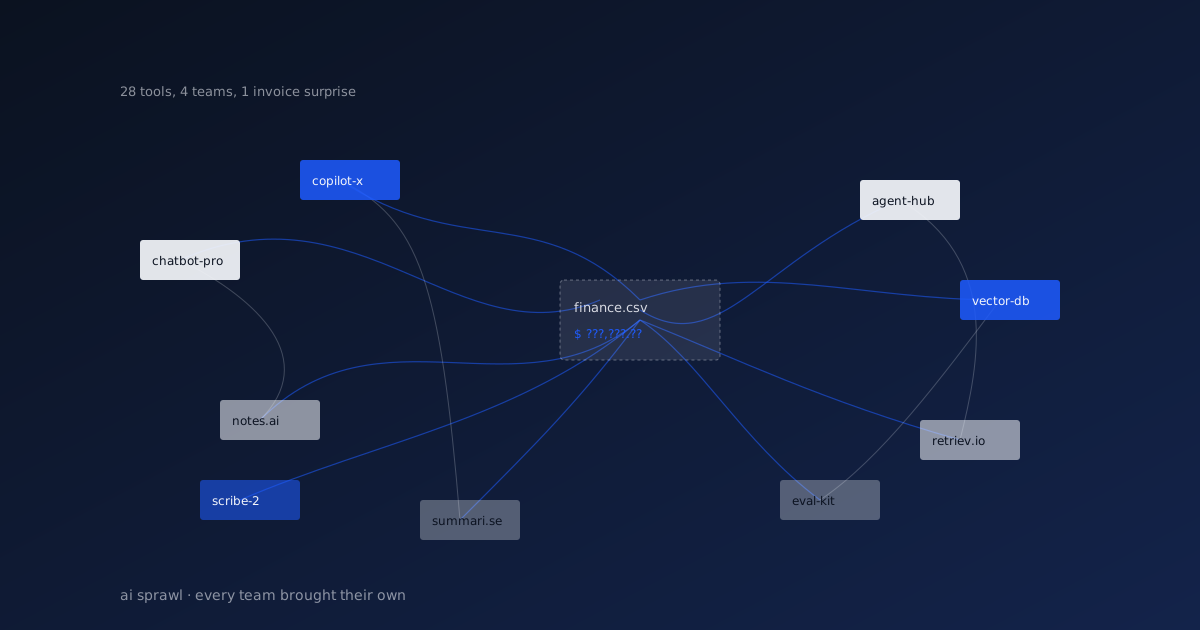
AI sprawl is the quiet accumulation of overlapping AI tools, copilots, assistants, and bots across an organization, without any one team owning the resulting system. It is the AI-era version of SaaS sprawl, with the same root cause — anyone with a credit card can adopt a tool — and an extra twist: each tool brings its own model, prompts, knowledge base, and log of what was said.
Definition
A typical pattern goes like this. Sales adopts a meeting-notes assistant. Support enables an in-product chat copilot. Engineering pays for a code assistant. Marketing pipes the brand voice into a third-party drafting tool. HR turns on the resume screener built into the ATS. None of these teams asked the others.
Within a year the company is running a dozen LLM-backed products, each holding partial copies of customer conversations, internal docs, and source code, governed by twelve different vendors. That is AI sprawl. It is not one bad decision; it is the cumulative effect of many reasonable ones.
Why it matters
Cost is the smallest part. The harder problems are the ones every CIO has now spent a quarter explaining: data exposure that the security review never saw, contradictory answers from different assistants that quote slightly different versions of the policy doc, and a quiet drift in which copy of the customer record is correct. The spreadsheet on someone's laptop becomes the source of truth because nobody trusts the assistants to agree.
There is a quality cost too. The same question — "what is our refund policy?" — answered four different ways by four different bots erodes user trust faster than no bot at all. And every tool added to the landscape is a new place where a prompt injection or a leaked context can leave the building.
Common misconceptions
It is not solved by buying a bigger platform. Large suites add their own assistants that themselves overlap with the point tools they were supposed to replace.
It is not the same as shadow IT. Many of the worst sprawl cases are fully sanctioned purchases by departments that had no reason to coordinate.
It is not purely a governance problem. Even with perfect approval workflows you still end up with overlapping retrieval indexes giving inconsistent answers — which is an architecture problem, not a procurement one.
The treatment is unglamorous: inventory what is actually running, pick a small number of shared substrates (one identity layer, one or two retrieval indexes, one logging pipeline), and make every assistant sit on top of them. Treat each new AI tool the way you would treat a new database — name an owner, name a data classification, name what gets deprecated when this one ships.
Short reading list
- Gartner, primers on GenAI strategy and tool proliferation — useful for framing the diagnosis to non-engineers.
- OWASP, Top 10 for LLM Applications — the classes of risk each individual assistant quietly contributes to the pile.
- Andrew Ng, The Batch — recurring argument for an "AI stack" mindset: fewer, shared layers under many applications.