Back to all writing in Economics & Deployment
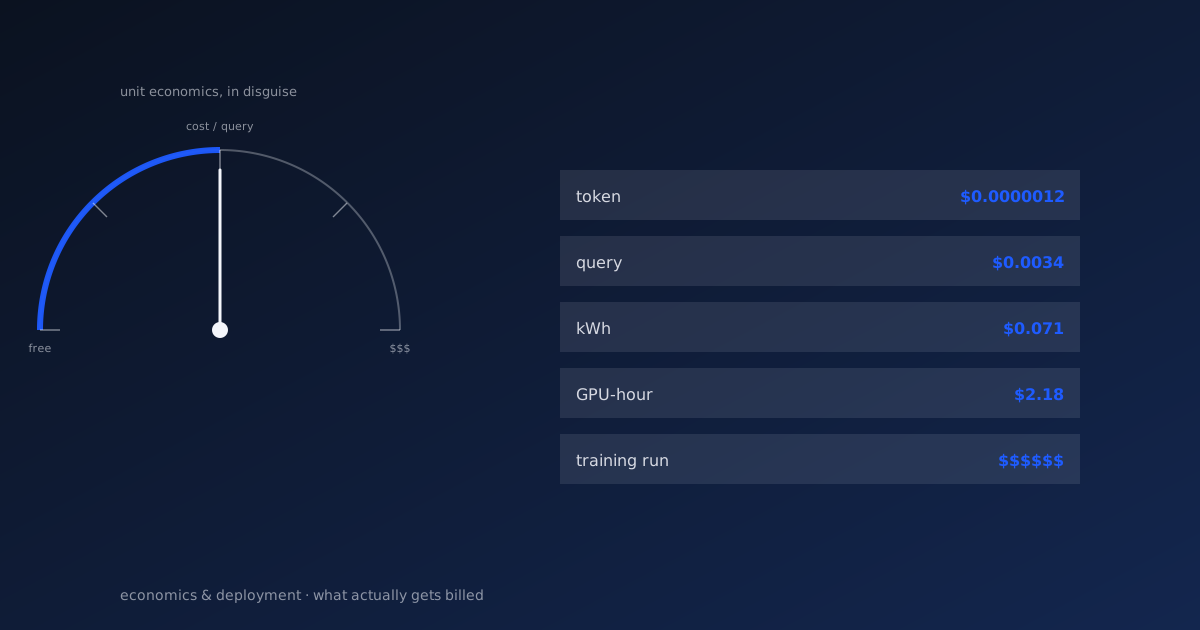
A surprising amount of AI discourse is really an argument about unit economics in disguise. “Will this replace search?” is downstream of “what does one query cost?” “Will every app embed a model?” is downstream of “how big does the model have to be, and where does it run?”
The Economics & Deployment pillar is for readers who want to think about AI the way an operator does — what gets billed, what gets stranded, and where the constraints actually bind.
Read these in order
- The real cost of a token — what API pricing is paying for, and why it keeps falling.
Where this pillar is going
Future essays will cover on-device inference (when the model lives on your laptop or phone), the datacenter buildout (power, water, and land), and open vs. closed weights as an economic question rather than a moral one.
Citations
- Carbon Emissions and Large Neural Network Training (Patterson et al., 2021) · accessed May 17, 2026
- Electricity 2024 — IEA (Wayback Machine snapshot, 2026-05-07) · accessed May 17, 2026
- Training Compute-Optimal Large Language Models (Chinchilla) — Hoffmann et al., 2022 · accessed May 17, 2026
Essays in this pillar
- Cost defragmentation: where AI money is actually wasted
AI bills are not high because tokens are expensive. They are high because the memory is sitting half-empty and the context is not being attended to.
~6 min read
- The real cost of a token
What API pricing is actually paying for — hardware, electricity, and a falling curve — and why this changes which apps make sense.
~3 min read